


-
Table of Contents
“Unlocking Composite Strength: The Key Role of Fiber Orientation.”
Introduction
Understanding fiber orientation in composite strength is crucial for optimizing the mechanical properties of composite materials. Fiber-reinforced composites, which consist of a polymer matrix embedded with fibers, exhibit unique strength and stiffness characteristics that are heavily influenced by the alignment and distribution of the fibers within the matrix. The orientation of these fibers can significantly affect the load-bearing capacity, impact resistance, and overall performance of the composite. By analyzing how different fiber orientations respond to various stress conditions, engineers and material scientists can design composites that meet specific performance criteria for applications in aerospace, automotive, and construction industries. This understanding not only aids in predicting failure modes but also enhances the efficiency of material usage, leading to lighter and stronger structures.
Importance of Fiber Orientation in Composite Materials
The significance of fiber orientation in composite materials cannot be overstated, as it plays a crucial role in determining the mechanical properties and overall performance of these materials. Composites, which are engineered from two or more constituent materials, often exhibit superior strength-to-weight ratios compared to traditional materials. However, the effectiveness of these composites largely hinges on the arrangement and alignment of the reinforcing fibers within the matrix. This alignment directly influences the load-bearing capabilities and durability of the composite structure.
To begin with, the orientation of fibers affects the tensile strength and stiffness of the composite. When fibers are aligned in the direction of the applied load, they can effectively carry the stress, resulting in enhanced performance. Conversely, if the fibers are misaligned or oriented randomly, the composite may exhibit significantly reduced strength and stiffness. This phenomenon is particularly evident in unidirectional composites, where fibers are aligned in a single direction, allowing for maximum load transfer along that axis. In contrast, multidirectional composites, which incorporate fibers oriented in various directions, can provide balanced strength and stiffness, making them suitable for applications where loads may be applied from multiple angles.
Moreover, the impact of fiber orientation extends beyond mere strength considerations. It also influences the composite’s resistance to various forms of failure, such as delamination and shear. For instance, when fibers are oriented perpendicular to the direction of shear forces, the composite may be more susceptible to shear failure. Therefore, understanding the specific loading conditions that a composite will encounter is essential for optimizing fiber orientation. Engineers and designers must carefully consider these factors during the design phase to ensure that the composite will perform reliably under expected service conditions.
In addition to mechanical properties, fiber orientation also affects the thermal and electrical conductivity of composite materials. For applications requiring thermal management or electrical insulation, the orientation of conductive or insulating fibers can be strategically manipulated to achieve desired performance characteristics. This versatility allows for the development of composites tailored to specific applications, ranging from aerospace components to automotive parts and even consumer electronics.
Furthermore, advancements in manufacturing techniques have enabled greater control over fiber orientation during the production of composite materials. Techniques such as automated fiber placement and 3D printing allow for precise manipulation of fiber alignment, resulting in composites that can be engineered to meet specific performance criteria. As a result, the ability to customize fiber orientation not only enhances the mechanical properties of composites but also opens new avenues for innovation in material design.
In conclusion, the importance of fiber orientation in composite materials is multifaceted, influencing not only mechanical strength and stiffness but also failure resistance and thermal properties. As industries continue to seek lightweight and high-performance materials, understanding and optimizing fiber orientation will remain a critical focus for engineers and material scientists. By leveraging advancements in manufacturing technologies and a deeper understanding of material behavior, the potential for developing next-generation composites with tailored properties is vast. Ultimately, the strategic manipulation of fiber orientation will play a pivotal role in shaping the future of composite materials across various applications, ensuring that they meet the demanding requirements of modern engineering challenges.
Analyzing the Effects of Fiber Alignment on Mechanical Properties
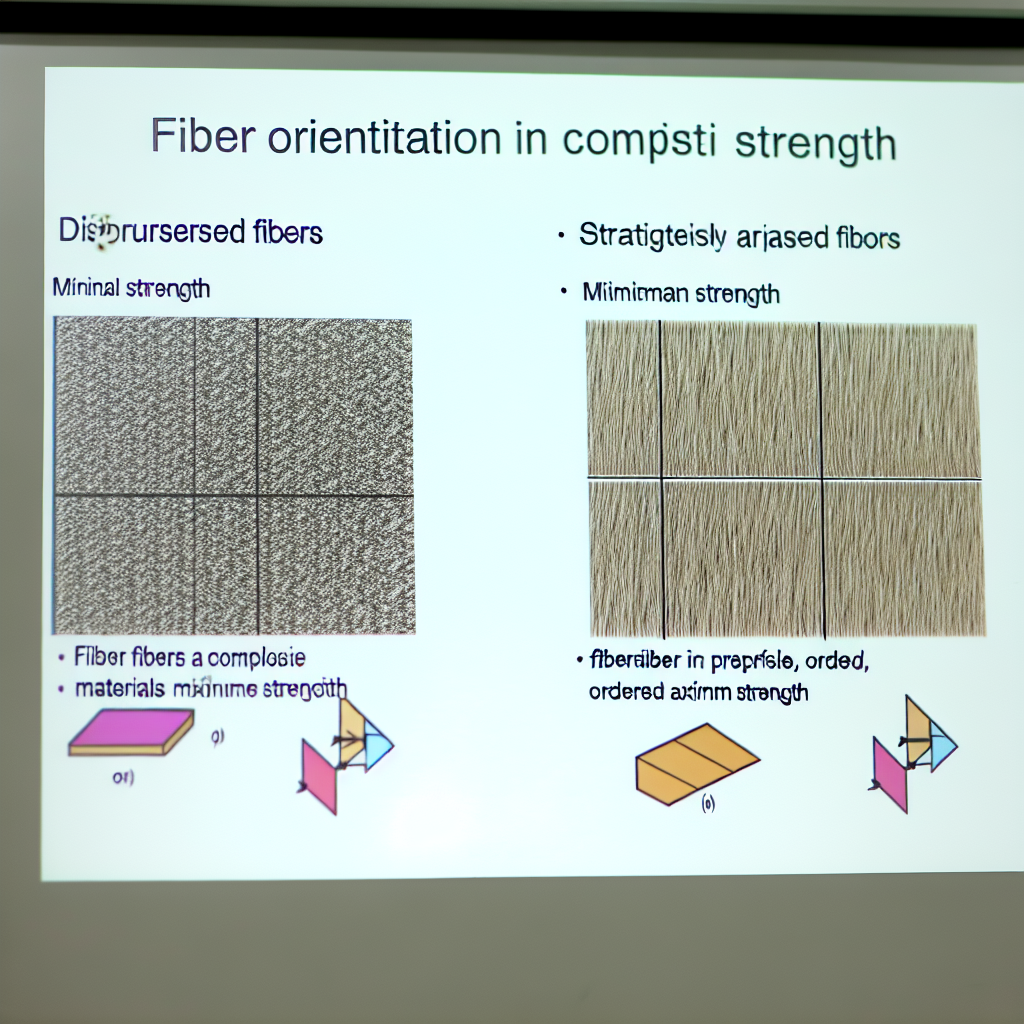
The mechanical properties of composite materials are significantly influenced by the orientation of fibers within the matrix. Fiber alignment plays a crucial role in determining the strength, stiffness, and overall performance of composite structures. When fibers are aligned in a specific direction, they can effectively carry loads, leading to enhanced mechanical properties. Conversely, misalignment or random orientation can result in diminished strength and stiffness, highlighting the importance of understanding fiber orientation in composite design.
To begin with, the alignment of fibers directly affects the load-bearing capacity of the composite. In unidirectional composites, where fibers are aligned parallel to the load direction, the material exhibits maximum tensile strength and stiffness. This is because the fibers, which are typically much stronger than the matrix material, can efficiently transfer stress along their length. As a result, the composite can withstand greater loads without failure. In contrast, when fibers are randomly oriented, the load is distributed across multiple directions, leading to a reduction in the effective load-bearing capacity. This phenomenon underscores the necessity of precise fiber alignment in applications where high strength is paramount.
Moreover, the mechanical properties of composites are not solely dependent on fiber alignment but also on the interaction between the fibers and the matrix. The matrix serves to bind the fibers together and transfer loads between them. Therefore, the effectiveness of fiber alignment is contingent upon the quality of the fiber-matrix interface. A strong bond between the fibers and the matrix enhances load transfer, thereby improving the overall mechanical performance of the composite. Conversely, weak interfacial bonding can lead to premature failure, even in well-aligned fibers. Consequently, optimizing both fiber orientation and the fiber-matrix interface is essential for maximizing the mechanical properties of composite materials.
In addition to tensile strength, fiber alignment also influences other mechanical properties such as flexural strength and impact resistance. For instance, composites with fibers aligned in the direction of bending loads exhibit superior flexural strength compared to those with random fiber orientation. This is particularly important in applications such as aerospace and automotive industries, where components are subjected to complex loading conditions. Furthermore, the impact resistance of composites can be enhanced by aligning fibers in a manner that allows them to absorb and dissipate energy effectively. This capability is vital for ensuring the durability and longevity of composite structures in real-world applications.
Transitioning from the effects of fiber alignment on strength, it is also important to consider the implications for manufacturing processes. The method of fiber placement can significantly influence the final properties of the composite. Techniques such as filament winding, pultrusion, and lay-up processes allow for precise control over fiber orientation. By selecting the appropriate manufacturing technique, engineers can tailor the fiber alignment to meet specific performance requirements. This adaptability is one of the key advantages of composite materials, enabling the design of lightweight yet strong components for a variety of applications.
In conclusion, the analysis of fiber alignment in composite materials reveals its profound impact on mechanical properties. The relationship between fiber orientation, load-bearing capacity, and interfacial bonding underscores the complexity of composite design. By understanding these dynamics, engineers can optimize the performance of composites, ensuring they meet the demanding requirements of modern engineering applications. As research continues to advance in this field, the potential for developing even more efficient and high-performance composite materials remains promising.
Techniques for Measuring Fiber Orientation in Composites
Understanding fiber orientation in composite materials is crucial for predicting their mechanical properties and performance. The arrangement of fibers within a composite significantly influences its strength, stiffness, and overall durability. Consequently, accurately measuring fiber orientation is essential for both the design and quality control of composite materials. Various techniques have been developed to assess fiber orientation, each with its own advantages and limitations.
One of the most widely used methods for measuring fiber orientation is optical microscopy. This technique involves examining thin sections of composite materials under a microscope, allowing for direct observation of fiber alignment. By analyzing the images captured, researchers can determine the orientation of fibers relative to a reference axis. While optical microscopy provides valuable insights, it is often limited by the need for sample preparation and the potential for human error in interpreting the images. Furthermore, this method may not be suitable for complex geometries or large-scale assessments.
In contrast, X-ray computed tomography (CT) has emerged as a powerful non-destructive technique for measuring fiber orientation in composites. This method utilizes X-ray imaging to create detailed three-dimensional representations of the internal structure of a composite material. By analyzing the orientation of fibers within these 3D reconstructions, researchers can obtain comprehensive data on fiber alignment throughout the entire sample. The non-destructive nature of X-ray CT allows for repeated measurements and the assessment of changes in fiber orientation over time, making it an invaluable tool in both research and industrial applications. However, the high cost and complexity of X-ray CT systems can be a barrier to widespread adoption.
Another promising technique for measuring fiber orientation is digital image correlation (DIC). This optical method involves capturing images of a composite material under load and analyzing the displacement of surface features. By correlating the movement of these features, researchers can infer the underlying fiber orientation and its effect on the material’s mechanical response. DIC is particularly advantageous because it provides real-time data and can be applied to various loading conditions. However, the accuracy of this method is highly dependent on the quality of the surface texture and the presence of distinct features for tracking.
Additionally, ultrasonic testing has gained traction as a method for assessing fiber orientation in composites. This technique employs high-frequency sound waves to probe the material, with the propagation speed and attenuation of the waves being influenced by the orientation of the fibers. By analyzing the ultrasonic signals, researchers can infer the fiber alignment and distribution within the composite. While ultrasonic testing is relatively quick and can be performed on larger samples, it may require calibration and validation against other methods to ensure accuracy.
Moreover, advanced computational techniques, such as finite element analysis (FEA), can also be employed to predict fiber orientation effects on composite strength. By integrating experimental data with computational models, researchers can simulate various loading scenarios and assess how different fiber orientations impact the overall performance of the composite material. This approach not only enhances understanding but also aids in optimizing the design of composite structures.
In conclusion, measuring fiber orientation in composite materials is essential for understanding their mechanical properties and ensuring their performance in practical applications. Techniques such as optical microscopy, X-ray computed tomography, digital image correlation, ultrasonic testing, and finite element analysis each offer unique advantages and challenges. By leveraging these methods, researchers and engineers can gain valuable insights into fiber orientation, ultimately leading to the development of stronger and more reliable composite materials.
Q&A
1. **Question:** What is fiber orientation in composite materials?
**Answer:** Fiber orientation refers to the direction in which the reinforcing fibers are aligned within a composite material, significantly influencing its mechanical properties and strength.
2. **Question:** How does fiber orientation affect the strength of composite materials?
**Answer:** Fiber orientation affects the load-bearing capacity; fibers aligned with the load direction enhance tensile strength, while misaligned fibers can lead to reduced strength and increased susceptibility to failure.
3. **Question:** What methods are used to analyze fiber orientation in composites?
**Answer:** Common methods include optical microscopy, scanning electron microscopy (SEM), and X-ray computed tomography, which allow for visualization and measurement of fiber alignment and distribution within the composite structure.